Sunday, 8 December 2013

Organic Change


Setting up business on the Hornsey Road Home of Blight is always a brave move, but the Organic Stall seems to be doing reasonably well. They're now selling pies. I approve of shops that sell pies. The lack of pies is one of the may ways in which the South is less civilised than the North. Even butchers here think they they can get away with being pie-less. There should be a law. The 'Pastry Enforcement Act 2014'. It could also tackle the scourge of pubs where 'pie' turns out to be a limp blanket of pastry over stew. IT IS NOT A PIE IF THERE IS NOT A PASTRY BASE.


Anyway. Kay now wants to change things and make the store into a community shop. To get there he needs 150 people to sign up a £6.99 direct debit per month (no cancellation period). To start with he'd use the money to buy a fridge, then he'd use it to lower prices. Then (and this is where it gets interesting) he'd be able to hire some help, spend more time sourcing products, negotiating with suppliers, doing events and suchlike.

Go talk to him about it. It's early days, but like Hubbub or the People's Supermarket it's the kind of idea that might give the high street strength.

Thursday, 5 December 2013

Christmas Carol on Hanley Road

Charles Dickens wrote a letter about visiting his sister Frances Elizabeth (Fanny) Burnett as she was dying in Hanley Road. It's here.

Embedded image permalink
Christmas on Hanley Road, 2013
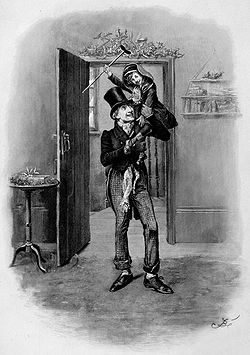
Fanny had studied music at the Royal Academy and married a tenor, Henry Burnett. Their son Henry Burnett Jr was what was then called 'sickly' and 'crippled' and would now be called sick and disabled. He was a thoughtful, kind child and the inspiration for Tiny Tim. He died shortly after his mother.

Tiny-tim-dickens.jpg
Bob Cratchit and Tiny Tim Cratchit as depicted in the 1870s by Fred Barnard, Wikimedia commons image.


Wednesday, 27 November 2013

Green House (Maison Verte)


Third despatch from the parallel baby world. This one is about something hard to find and worth finding.

The toys in the photograph are in a large, well-lit room. Pan out and you'd see playthings for slightly older children: china teacups, buckets and water to fill them with, plastic motorbikes made wide and squat enough for toddlers.

Look around and as well as the children and their parents/carers you'd also see three or four other adults, a mix of psychologists and other childcare professionals. They're all easy to talk to and it's interesting to see them interact with the children, letting them take the lead and shape their own play. 

They're here because of her:


Francoise Dolto was a psychoanalyst who did many things, but what she's most remembered for is setting up 'green houses', places for children to explore the world outside their homes and for parents to have a reprieve from being alone with their children. De Gaulle and Andre Malraux (culture minister & the man who saved medieval Paris) got involved and the idea spread to St Petersburg and Barcelona, Belgium and Argentina. 

And now they're here.

For children 3 and under. Open Wednesdays 9:30 to 12:30 and Fridays 12:30 to 3:30. Free, but you're also free to make a donation.

It's in the 'community rooms of Finsbury Park community hub N7 7RW'. This translates as the other side of Durham Road from Poole's Park primary school, just inside the Andover Estate. Here's the  outside:


Trust me, it's worth going in. 

Thursday, 21 November 2013

Bavaria Road


The Post Office spent decades shuffling through British street names, thinning out the Church Streets and Station Roads. 

Blenheim Road off Hornsey Road was swept up in this alongside at least six other Blenheim-somethings. It's a neat renaming. John Churchill became 1st Duke of Marlborough after defeating the Bavarians at Blenheim in 1704, and Marlborough Road is the next crossing on the left.

Monday, 18 November 2013

And they all went into the Ark, for to get out of the rain.


The Ark (a stay and play for under 5s) is on Tuesdays from 10 to 11:30 in St Mark's church, off Tollington Park. No charge, but there's a donation box.  

Since I took the photograph they've put up a banner. This is good. Before you had to guess what was behind a door with a sign about food vouchers. 

Inside there's enough kindness to justify the C of E, synod, bishops, Westminster Abbey and all. There's no overt god-bothering or sense that any non-anglicans are unwelcome but it's a small, practical, repeated miracle.

I've long had a theory that middle-class people are spontaneously generated by fancy places. Open a cafe with a blackboard paint wall in the roughest part of London and watch the men with beards and cardigans appear. The Ark's the same, except with friendly, competent people instead of hipsters. 

Second in an occasional series about the parallel baby world. The first post is here.

Thursday, 14 November 2013

Iain Webb 'Shaking the Ether'

Lapwing, a small press based in Belfast, published this in 1995:

'Driving through rain sheaves weather's cloud-handkerchief wipes Napoleon's nose
Vehicle tuts, shakes its head philosophically, longing for the old London routes
Charing Cross, Cricklewood, Muswell Hill, Hornsey Road, Trafalgar Square.'

I like to imagine the 91 singing it.


Tuesday, 12 November 2013

Morals, or Why Lewis Walker lived ten weeks and didn't matter.

Islington Gazette, 1872

'Dr Lankester held an inquest on Thursday last, at the 'Eaglet', Seven Sister's road, on the body of Lewis Walker, aged ten weeks.

According to the evidence of the father of the child, Daniel Walker, a greengrocer of 54 Andover road, it appeared that the mother of deceased died on the 1st September, and deceased had since been brought up by hand.


[Andover Road was on what's now the Andover Estate and was a filthy, disease riddled hole. Bringing up 'by hand' meant feeding the child watered down condensed milk or some other pap.]

 Latterly, it had diahrrea, and Dr Davidson prescribed for it on Saturday week. The child rallied a little, but then got bad again. It was then put out to nurse, but had no further medical attendance till it was in a dying state on Saturday night. The child died on Monday morning and the medical man, Mr Popham, refused a certificate.

[love the 'it']

Mr H. Home Popham stated that he saw the child on Saturday night, when it was in a state of syncope and so emaciated that he thought it had been ill-treated, and refused a certificate. On examining the body he found it emaciated but clean. On the head was a small bruise, apparently from a fall. Internally the mesentric glands were degenerate, and his opinion was that the child died of exhaustion from diarrhea.

There being no evidence to show that the child had been neglected in any way.

[Except for being starved]

A  verdict of 'Death from natural causes' was returned, and the Jury added that its death was accelerated by want of natural food. They also wanted to append an opinion that the inquest was unnecessary, but the the Coroner disputed their right to do this, stating that, as two medical men had refused to give certificates of the cause of death, there were fully sufficient grounds for holding the inquest. 

He also contented that the jury had no right to express an opinion as to the necessity for an inquest; they were only asked to record their opinion as to the cause of death. Some people, no doubt, thought the Queen should not sit on the throne, but they would get no judge in the kingdom to record such an opinion in a verdict. He was simply there to administer the law. He might say that, as it had been rumoured about the neighbourhood that the child had been neglected, the father ought to feel thankful for the inquiry.

[Starvation isn't neglect?]

Some of the jury refused to sign the verdict, 

[Because they thought the child had been neglected? Or because they thought their time had been wasted?]

but as the coroner threatened to lock them up all night twelve submitted and signed.'