Wednesday, 11 February 2015

Divine Light at number 465b.

The Hornsey Road was the Devil's Road, but there are many ways to God here. Anglicans at St Mark's and Emmanuel, Baptists just behind the Plough, Spiritualists, Muslims in Leslie Compton's old pub,  There were even Methodists once.

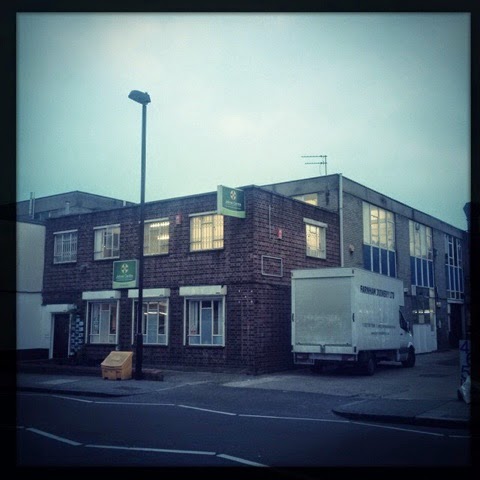
The quietest way is through a low brick building with water-bottles-turned-terrariums around the front door at number 465b.


 This is the 'Johrei' centre and Johrei is a Japanese religion founded in 1920 and keen on organic farming - from which the terrariums. The ground floor looks like offices and the upper floor looks like this:


I went there on Wednesday with small person. There were three or four women inside, none of them Japanese, two of whom offered me 'healing'. I said yes because how else could I write about it? She held her hands near me and we talked. There was no attempt to sell me any thing or any belief. It was rather nice. 

Small person ran about playing with keys - children are welcome everywhere but on the altar. 

'JOHREI is the name given to the channelling of a spiritual energy or Divine Light to purify one’s spiritual body and awaken our divine nature. In Japanese, Johrei means “purification of the spirit”. Its main purpose is to awaken the soul to the power of the Divine Light, which can change self-centred lives into God-centred ones. Johrei is an action which brings about spiritual fulfilment and true happiness on Earth.'

What you make of that will depend on what you make of that sort of thing and whatever that is nothing I write should change your mind.

Saturday, 7 February 2015

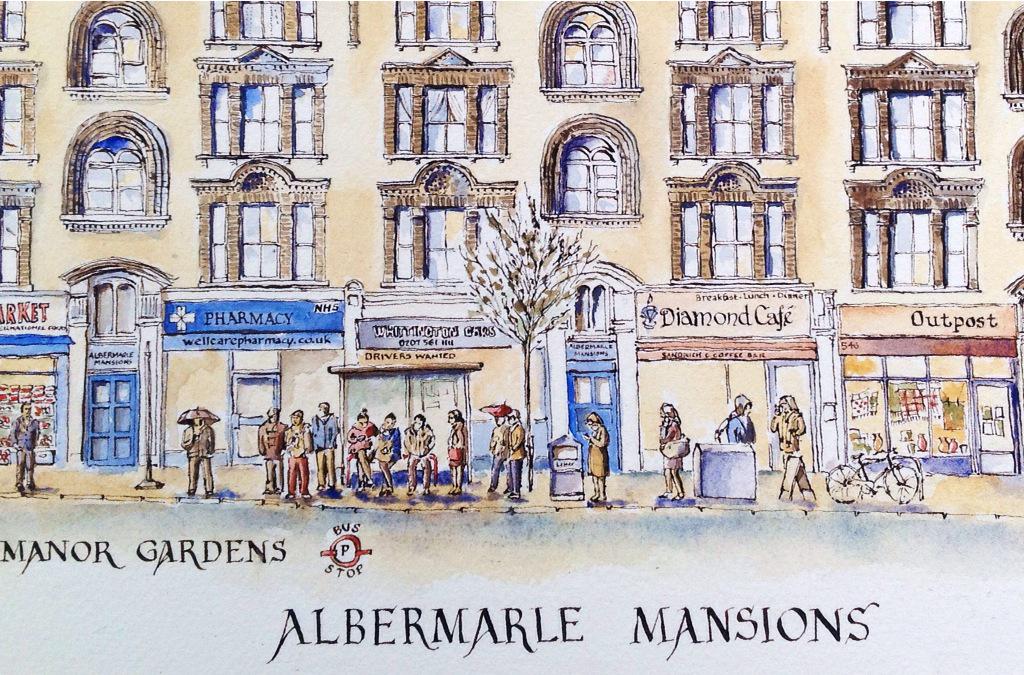
Albemarle Mansions Part Three: Outrages

Embedded image permalink
By @ronniecruwys of drawingthestreet.co.uk
This is the last of the Albermarle Mansions stories and it might be the best. Here goes:

'Stated by the police to be considered in Ireland a very daring and dangerous criminal, George Green (34) whose address was given as Albemarle Mansions, Holloway, was convicted with Herman Rowland Panzer* (39), of the same address, of the theft of a duplicating machine from an office at Isleworth, at Brentford today. 

The police said that Green had been convicted for causing assemblies, for being responsible for outrages, for escaping from Cork prison, and for shooting at an inspector for which he had had 20 strokes of the cat. 

In this country he had been convicted for robbing a bank and for being concerned in the stealing of firearms and 10,275 rounds of ammunition. He was, added the police, a very daring gunman who did not hesitate to shoot to avoid arrest. 

Green and Panzer were sentenced to six months' imprisonment on the present charge.'

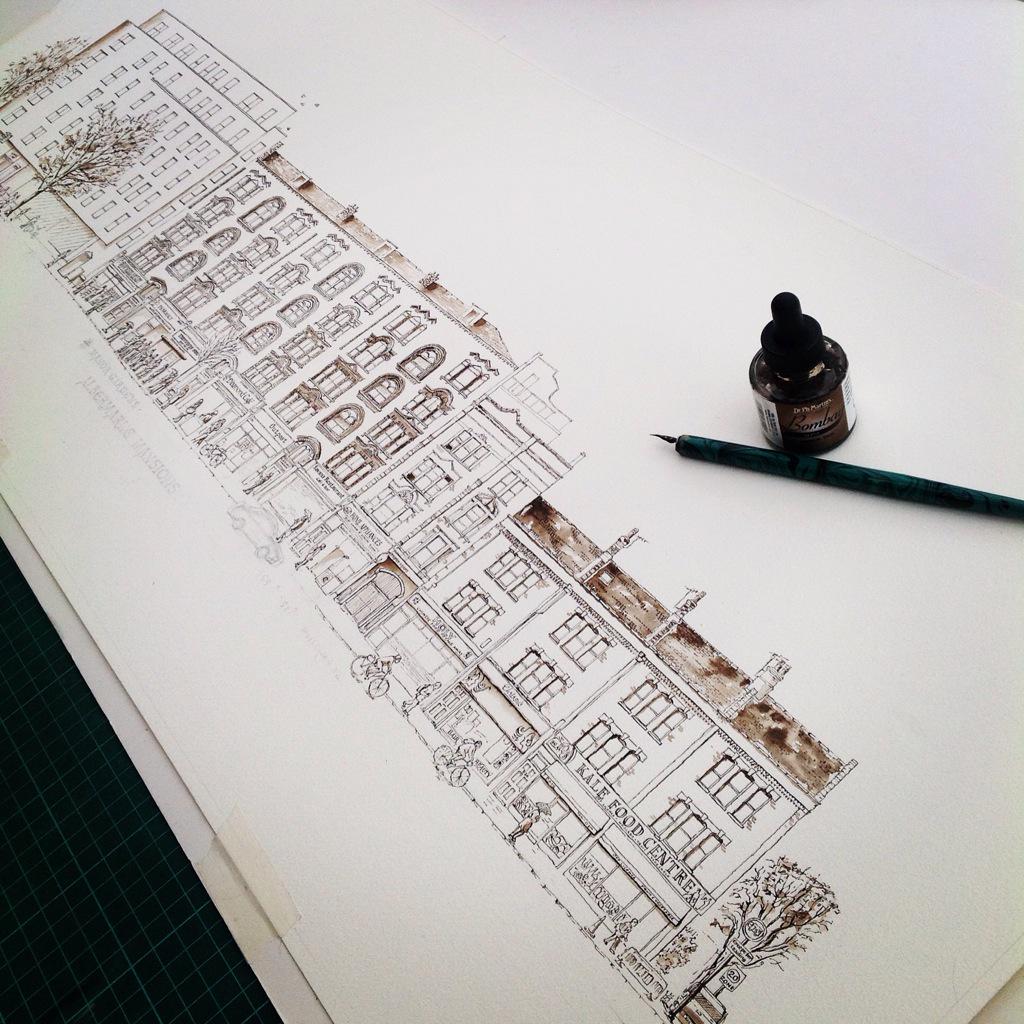
Embedded image permalink
By @ronniecruwys of drawingthestreet.co.uk

This piece appeared  word for word in the 3 April 1929 editions of the Derby Daily Telegraph, the Gloucestershire Echo, Hull Daily Mail, the Hartlepool Mail, and the Nottingham Evening Post. On 4 April the Western Daily Press picked it up. None of the London papers covered it. There are no follow-up pieces.  Here goes:

'Duplicating machines' are early photocopiers. They're not the kind of thing you'd steal if you were just a thief because they're heavy and anyway, what would you do with one? That's the first hint that we're not dealing with a standard criminal, but with someone who might have wanted to distribute pamphlets or leaflets.

'Causing assemblies' could refer to trade union activity, or to any other form of activism. The link to Ireland means that I.R.A. is the most likely answer.

In 1923 dozens of I.R.A. veterans had escaped from Cork city gaol with the men who facing death going first and the rest waiting their turn according to the length of their sentence. It's one hell of a story  (see here).** I can't find any mention of a George Green that fits the bill in the online prison archives, but if this were a proper research project rather than what it is I'd wouldn't have given up there.

The Cork prison escape story seems to have been reported only in a short piece in the Western Daily Press.*** Perhaps Irish news didn't sell. Perhaps the Government of the day wasn't keen on the story being covered (but would they have had that much influence on the press? Perhaps the prison authorities in Ireland managed to keep the story quiet?


* A 'Herman Roland [not Rowland] Panzer' was living in 7 Parkhurst Road, Islington 1911 as a 'disengaged' clerk. This thread suggests strongly that he also went by the name of Armyn Roland Panser and married bigamously under both names.
**You can go on a team-building 'Jail Break' adventure at the gaol building. The people who came up with that idea are now working on 'Potato famine: the cook book'. 
*** That's all that turns up if you search for 'Cork City Gaol' and 1923 in britishnewspaperarchive.co.uk

Thursday, 22 January 2015

Leslie Compton at the Hanley Arms


There is a photograph of Leslie Compton serving a pint to Tom Whittaker, the Arsenal manager, from behind the bar at the Hanley Arms..

This proves that Leslie Compton was indeed the landlord of the Hanley Arms.

I've spent a lot of time trying to prove that Leslie Compton was the landlord of the Hanley Arms.

Possibly too much time.

I was going to show you the picture, but the Press Association would have charged me £40 per year. Um. It's here (Daily Mail link).

It is very Hornsey Road that it should be Leslie and not Denis. Leslie played 273 times for Arsenal and scored 5,000 runs for Middlesex and still got overshadowed by his younger brother.

Here's Neville Cardus on Denis, via the Telegraph obituary page:

"Never have I been so deeply touched on a cricket ground as I was in this heavenly summer of 1947 when I went to Lord's to see a pale-faced crowd, existing on rations, the rocket-bomb still in the ears of most folks - and see this worn, dowdy crowd raptly watching Compton.

The strain of long years of anxiety and affliction passed from all heads and shoulders at the sight of Compton in full sail, sending the ball here, there, and everywhere, each stroke a flick of delight, a propulsion of happy, sane, healthy life. There were no rations in an innings by Compton,
"

Tuesday, 20 January 2015

Albemarle Mansions Part One: Six Pairs of Silk Tights

@RonnieCruwys of www.drawingthestreet.co.uk is drawing the Holloway Road. I hope to drag her eastwards someday soon. In the meantime, here's a preview of her Albermarle mansions (near Manor Gardens) and the first of four stories from local papers.

Embedded image permalink


This one's an advert from the 8 October 1898 'The Era'.

'Wanted, to Sell, Six Pairs of Silk Tights, Two Auburn Wigs and Two Sets of Band Books. 16 Albemarle-mansions, Holloway Road, N.

The Era was the 'Actor's Bible' and 'Band Book' means sheet music. Pantomime dame fallen on hard times? 


Wednesday, 31 December 2014

On looking up at Bathhurst Mansions and finding Orson Welles


Bathhurst Mansions on 458 Holloway Road is an uncommonly pretty building. The ground floor's been turned into drab tat, but look up and (thanks to @RonnieCruwys of drawingthestreets.co.uk) there's all this: 


There's also a story about Irish theatre, queer history and Orson Welles. Here goes:

Hilton Edwards was born in Bathhurst Mansions on 2 February 1903. He'd grow up to direct Welles in his first and last role on stage and (with Micheál Mac Liammóir born Alfred Willmore in Kilburn - see his one-man 'Wilde' here) to live something damn close to an openly gay life in Ireland, 

From  THE TRINITY NEWS (a Dublin University Weekly)  March 10, 1960
CHIMES AT MIDNIGHT -- Gaiety Theatre
Few men of the present day theatre have sought so consistently to throw off the shackles of conventional drama as Hilton Edwards and Orson Welles have done. The combination of their talents promised an exciting evening's theatre--a promise which was richly fulfilled. In Chimes at Midnight, each part of Shakespeare's Henry IV has been cut to about a third of its length, and the two have then been skilfully welded into a coherent narrative by the introducton of a spoken commentary taken from Holinshed's Chronicles.
In the original, Falstaff's part in the action is almost incidental, but in this adaptation it is his relationship with young Hal, and the latter's relationship with his father, which are the main themes. The martial and political events of Shakespeare's two plays are very lightly passed over in this adaptation; Hotspur, for example, is given no time to develop as a character. A great deal of expendable Shakespearian material has been cut; the aim is to give a stirring impression of swift-moving events. The one weakness in the play lies in the ending, where Prince Hal's contemptuous  dismissal of Falstaff seems to point too narrow a moral. Kingly duty, for all its sanctity, seems to be a hollow thing when pitted against Falstaff's lovable vitality. It is true that the defect is present in Shakespeare's original, but it was intensified in the adaptation by the fact that the martial and patriotic aspects of the story received so little emphasis.
With this malleable material at his disposal, Hilton Edwards had ample scope for the demonstration of his fluid conception of the drama. The stage, which had several levels was left bare, although occasional use was made of representational pieces of scenery which served merely to suggest the setting. An army in progress was represented by a roll of drums and a man in armour carrying a banner. The deliberate avoidance of naturalistic effect had the result of vividly stimulating the imagination of the audience, and of imparting an extraordinary pace and panache to the production.
The acting varies from the mediocre to the brilliant. Orson Welles fills the stage with his immense bulk and his hugely whiskered face, and the theatre with his resonant vice and powerful dramatic presence. he captured the boastfulness, the mock hyprocrisy, the lovableness and the cowardice of the Fat Knight. yet there seemed to be something lacking. Perhaps the actor was tired after after the afternoon matinee, but Welles failed to put across the immense vigor of Falstaff. This lethargy extended even to his verse-speaking; his throwaway technique was engaging, but one quickly felt a lack of variation.
Keith Baxter as young Hal gave a performance of great dash and energy which was slightly marred by a lack of smoothness in his diction Reginald Jarman was superb as the King; he gave just the right impression of tortured strength, and he spoke the verse with noble authority. In smaller roles Patrick Bedford was a lively Poins, and Shirley Cameron conveyed admirably the earthy pathos in the character of Doll Tearsheet.
This is a memorable production, in which one partcular moment and one scene stand out. The moment is the sudden, shattering pathos which Welles brings to Falstaff's simple statement to Doll: "I'm old," and the scene, that in which whcih we see the dying King, alone and helpless, with only his crown beside him, in the huge emptiness of the stage.
B. R. R. A.

Friday, 5 December 2014

Bridging the gap to 1914

There were people standing outside the W. Plumb butcher's shop the other week, the first queue it's seen for years, maybe decades.


This was why:


14 young actors from the Brit School (the Adele & Amy Winehouse one) were playing the Plumb family in 1914, with the boys eager to go to war and the girls saying goodbye.

Here they are:


It worked. The space is atmospheric/spooky enough that everything feels distanced from the world outside, and the actors used their youth to be vulnerable and lost, then somehow switched it off (how, I have no idea) to act the adult parts. There was a girl with a very beautiful voice, a boy who turned first into Henry V and then into a butcher and another boy who went from child to corpse to meat. 

More things like this would be good.


Saturday, 29 November 2014

Effeminate and Obstinate

This story makes sad and strange reading.

In 1875 William Stafford, an attorney and solicitor living at 49 Hanley Road, was taken to court on the charge of having unlawfully assaulted his illegitimate child, William Stafford, on the 24 of May.

[Bastard, but with his father's name - how did that work?]

On Friday 11 June the  Morning Post reported that 'the complainant, a boy about 14 years of age, stated that his father had twice beaten him so badly that he was compelled to leave his home and go to the Islington Workhouse. 

On the day mentioned in the summons the defendant beat him with a whip which he made him fetch and subsequently when the defendant had had his bath he ordered him to have one and when he was undressed the defendant beat him most unmercifully with a broom. 

The boy acknowledged that he had worried his father, but not until he had made him do so by threatening him. The defendant turned him out of the house, having previously beaten him with a whip on the legs and back. 

There were marks on him where the defendant had beaten and knocked him, and there were also marks of violence on his legs.

Mr Sustins, the master of Islington Workhouse, said the defendant had told him that the complainant was illegitimate, as were his six other children. 

[6 other children?]

On the 6th of May when he examined the complainant at the workhouse he was bruised from head to foot and there was not a place on his body as large on his hand that was free from bruises. 

There were marks on his body and back as if caused by a whip and his flesh was much discoloured. There were marks on his side, stomach, back, body and hips.

Mr Philip Cowne, surgeon of the workhouse, having deposed to the bruises on the boy, said that from his general observation of the boy he had come to the conclusion that he was effeminate and obstinate.

[I'm not sure what 'effeminate' means here. It seems to be put forward as a justification for the father's actions. Perhaps the idea behind it is that a milksop of a boy needs toughening up? Perhaps 'effeminate' is code for homosexual and therefore corrupt and deserving of punishment?]

The defendant said he should reserve his defence and his witnesses for the sessions. He hoped that the magistrate would take his own recognaisance for his appearance. Mr Cooke said he could not do that. He must have some surety in the sum of £25.'

On Tuesday 15 June they are back in the Morning Post. This time the assistant judge is addressing the Grand Jury. 

He says that every father has a right to correct his child, that the boy did not appear to have suffered in health and was by his own admission mischevious and disobedient. 

He also says that 'corporal chastsement [...] should be administered with moderation and not with a vindictive spirit or a cruel indifference.  

He does not, I think, much like the father.

The father was fined £10 plus costs and ordered to keep the peace towards the boy for 12 months. The 20 June Reynolds's Newspaper reported the sentence under the heading 'Cruelty to a Child'.